Elgin Walking and Non-Drug Therapy for Back Pain and Stenosis
Lumbar spinal stenosis and its related back pain is common and troubling for its sufferers. Dementia, neurogenic claudication, reduced walking distance, poor balance, reduced quality of life, and altered posture often accompany spinal stenosis. Disc herniations, disc degeneration, and other spinal canal space intruders invite spinal stenosis. At Connected Chiropractic, Elgin spinal stenosis patients who want to uninvite spinal stenosis have someone to help.
THE IMPACT OF LUMBAR SPINAL STENOSIS
Research continues to present lumbar spinal stenosis as being linked to conditions like dementia development, walking capacity, and reduced quality of life. A new study stated that lumbar spinal stenosis was an independent risk factor for acquiring dementia. Of 1220 patients, 10.8% of the lumbar spinal stenosis patients experienced dementia as opposed to only 4.4% of the control group members. (1) Older adults with lumbar spinal stenosis were described as modifying their posture with a forward bend to improve their ability and tolerance for walking. Researchers who looked into this phenomenon found that this posture was more of a forward shift of the pelvis while standing and walking. They concluded that limited walking in symptomatic spinal stenosis patients was more related to spine loading which rose 7%. (2) Whatever it is linked to, reduced walking ability isn’t good. Someday it will be nice to understand more clearly the role of stenosis in relationship to slowed walking, but for now, Connected Chiropractic will keep encouraging walking for spinal stenosis patients, slow and steady and distance furthered as tolerated.
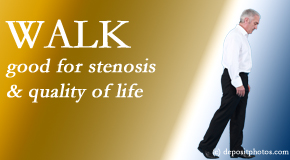
THE TREATMENT OF LUMBAR SPINAL STENOSIS: Walk
Since spinal stenosis is so common a condition in older folks, multiple guidelines and articles are issued and with good reason. Reduced ability to walk and quality of life are recorded side-effects of lumbar spinal stenosis. These two issues remain the leading gauges for back surgery in older patients. Sadly, 40% of those who undergo spinal surgery for the lumbar spinal stenosis still state difficulty with walking after surgery. (3) Recommendation 1 of a newer guideline for handling lumbar spinal stenosis and associated neurogenic claudication suggested non-surgical multimodal care to include non-drug therapy with education, advice, lifestyle changes, home exercise, manual therapy, acupuncture (trial), rehab, and therapy. (4) An update to the 2013 Cochrane review of research reports on the outcomes of treatments for lumbar spine stenosis related neurogenic claudication that decreased walking revealed that manual therapy and exercise to improve walking distance together was a beneficial treatment method. Epidural steroids weren’t. (5) Conservative, non-surgical care of Elgin spinal stenosis is endorsed by spine researchers and by Connected Chiropractic.
CONTACT Connected Chiropractic
Listen to this PODCAST with Dr. Nate McKee on The Back Doctors Podcast with Dr. Michael Johnson as he illustrates the relief with The Cox® Technic System of Spinal Pain Management for a patient with lumbar spinal stenosis and balance issues. Relief with Cox® Technic is described.
Make your Elgin chiropractic appointment today for increased walking and decreased back pain due to Elgin lumbar spinal stenosis!